Manoj Singh, Former ACS, UP Government
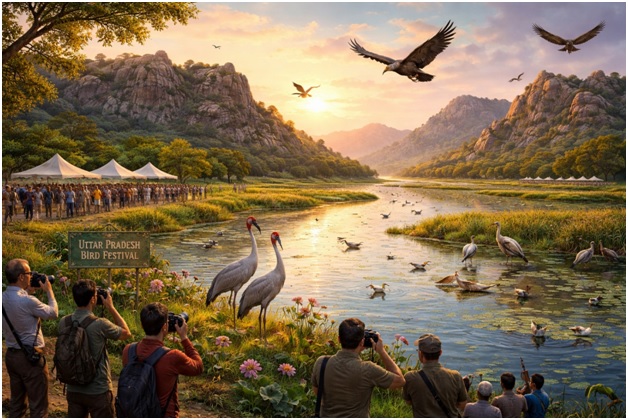
In the rugged granite folds of Bundelkhand, where the Betwa Reservoir mirrors the sky and the cliffs of Mahavir Sanctuary in Lalitpur rise like ancient sentinels, the Uttar Pradesh Forest Department’s Bird Festival unfolded not merely as an event, but as an ecological dialogue. Here, vultures breed naturally on rocky escarpments, reclaiming a lineage once pushed to the brink across the subcontinent. Scientists, forest officers, administrators, students, and conservationists gathered in a landscape where thermals carry wings and wetlands cradle life—reminding us that birds and water are bound by an ancient covenant.
This festival was not ornamental celebration; it was ecology made visible, audible, and participatory.
Objectives of Bird Festivals Near Wetlands
Bird festivals serve as conservation interfaces, translating scientific understanding into public consciousness. Their objectives extend beyond birdwatching. They promote avifaunal awareness by highlighting wetland-dependent species, migratory corridors of the Central Asian Flyway, and keystone scavengers such as vultures. They encourage community stewardship, transforming local residents from passive resource users into active custodians of wetlands. They foster policy convergence by creating platforms where science, governance, and field forestry interact. Most importantly, they build wetland literacy—communicating ecosystem services that remain invisible yet indispensable.
At Mahavir Sanctuary, the narrative deepened further: vultures were reframed not as omens of death but as surgeons of the ecosystem, whose absence once destabilized trophic balance and public health.
Bird Festivals as Ecological Catalysts
Bird festivals near wetlands perform a critical eco-social function. They act as bio-cultural bridges, reconnecting people with landscapes they inhabit but often overlook. They revive fragments of traditional ecological knowledge—once embedded in fishing cycles, monsoon predictions, and bird calls. They promote citizen science initiatives, bird censuses, and long-term monitoring efforts essential for adaptive wetland management.
A wetland without birds is a silent instrument; a bird festival helps tune it back into the ecological orchestra.
Wetlands–Bird Relationship: A Functional Symbiosis

Wetlands are not merely habitats; they are biogeochemical engines. For birds, they provide nutrient-rich foraging grounds, safe nesting matrices shaped by hydrology, seasonal stopovers for migrants, and buffers against climatic extremes. In return, birds perform vital ecosystem services—nutrient cycling, seed dispersal, insect population control, and bio-indication of ecological health.
Vultures, nesting on Bundelkhand’s cliffs and feeding across wetland-linked landscapes, complete this cycle by accelerating carcass decomposition and limiting disease spread, reinforcing ecological equilibrium.
Ramsar Wetlands of Uttar Pradesh: Living Archives
Uttar Pradesh hosts several Ramsar-designated wetlands, including the Upper Ganga River stretch, Saman, Samaspur, Sandi, Bakhira, Parvati Arga, Nawabganj, SarsaiNawar, and Haiderpur. These ecosystems function as hydrological kidneys, filtering pollutants and recharging aquifers. They act as carbon sinks, sequestering organic matter in sediments and vegetation. They serve as avian refugia, supporting thousands of resident and migratory birds. They moderate floods and microclimates in an era of intensifying climate change.
Wetlands and Climate Resilience
From a climate perspective, wetlands store carbon, attenuate floods, and regulate local temperatures. Their degradation transforms them from carbon sinks into carbon sources, amplifying risk. Protecting wetlands through public engagement—such as bird festivals—therefore becomes climate adaptation embedded within culture.
Bird festivals near wetlands are not peripheral cultural gatherings; they are ecological interventions. They restore visibility to fragile relationships between water, wings, and climate. In Uttar Pradesh, where Ramsar wetlands punctuate the plains like emerald pauses in a long civilizational narrative, such festivals ensure that this story continues—resilient, readable, and alive.
When wetlands breathe, birds sing.
When birds return, balance follows.